

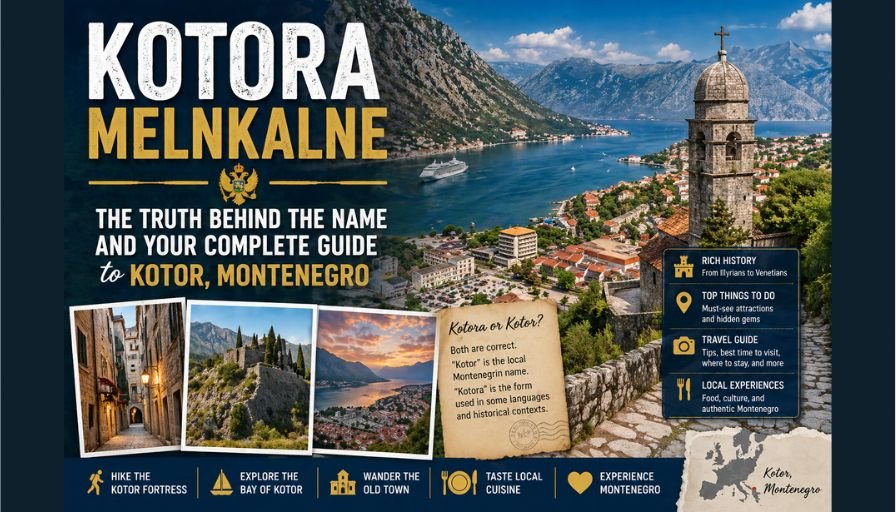
If you searched for Kotora Melnkalne and arrived here expecting to find a secret village, a hidden artist, or a mysterious undiscovered destination, the first thing to clarify is that Kotora Melnkalne is not a place you will find on any map under that name. It is not a secret village. It is not a newly discovered travel destination. It is a Latvian-language phrase that means, quite literally, Kotor, Montenegro.
What Is Kotora Melnkalne? The Clear Answer
Kotora Melnkalne is the Latvian translation of Kotor, Montenegro. Breaking the phrase down:


- Kotora is the Latvian form of Kotor, a medieval walled coastal town in the Bay of Kotor in southwestern Montenegro.
- Melnkalne is the Latvian name for Montenegro. Melns means black and kalne means mountain in Latvian, making Melnkalne a direct translation of Montenegro, which itself means Black Mountain in Italian and Venetian.
The combination therefore means nothing more than Kotor, the city in Montenegro. It entered international search interest primarily because automated content systems encountered the Latvian phrase in map data and, failing to identify it as a translation, began treating it as if it were an independent name for an unknown or secret place.
Once this error propagated across a few content sites and generated search volume, the self-reinforcing nature of SEO content production took over, with more articles appearing about the supposed mystery of Kotora Melnkalne, each one further amplifying the keyword without adding any genuine information about what the phrase actually refers to.
The real destination behind the name, Kotor, Montenegro, is not a hidden gem. It is a well-documented, internationally recognised, frequently visited UNESCO World Heritage Site. But it is also genuinely magnificent, and the misplaced curiosity generated by the Latvian translation may at least have the positive effect of directing some visitors toward a place that genuinely rewards exploration.
Kotor, Montenegro: The Real Place
Kotor is a medieval walled city on the Adriatic coast of Montenegro, situated at the innermost point of the Bay of Kotor. The bay is a dramatic geographical formation created when the sea flooded a series of river canyons carved through the limestone karst of the surrounding mountains. The result is a body of water that looks more like a fjord or a series of interconnected lakes than a conventional coastal bay, enclosed by steep mountains that rise directly from the waterline.
The town itself sits with its back against one of these mountain walls, and the fortifications that define its famous skyline climb the cliff face above the old town in a sequence of walls and towers that wind upward to the fortress of St John, perched hundreds of metres above sea level. From the fortress, the view over the bay is among the most striking in Europe: dark mountains, deep blue water, and the terracotta rooftops of the old town laid out below.
A Brief History of Kotor
Human settlement in the area around Kotor dates back at least two thousand years, with evidence of Illyrian occupation predating the Roman period. The Romans recognised the bay’s strategic and commercial value and developed the town as a significant port. The trade routes that ran through this part of the Adriatic coast made Kotor a prosperous and contested location throughout its history.
The most visually dominant influence on Kotor’s architecture and urban layout is the period of Venetian rule, which lasted from 1420 to 1797. The Venetian Republic invested heavily in Kotor’s fortifications and civic buildings, leaving behind the characteristic stone walls, the loggia in the main square, numerous palaces, and the administrative and religious buildings that define the character of the old town today. The cat, which has become an unofficial symbol of Kotor, was brought to the city by Venetian sailors according to local tradition and remains a visible presence throughout the streets.
Following the fall of Venice, the town passed through Austrian, French, and again Austrian rule before becoming part of Yugoslavia and eventually the independent Republic of Montenegro. Throughout these transitions, the old town’s medieval structure remained remarkably intact, which is a significant reason for its UNESCO designation in 1979.
Kotor as a UNESCO World Heritage Site
Kotor’s Old Town was inscribed on the UNESCO World Heritage List in 1979 under the designation Natural and Culturo-Historical Region of Kotor. The designation recognises not just the town’s architectural heritage but the entire surrounding landscape, including the bay, the mountains, and the network of historic settlements along the shoreline.
The specific elements that earned the designation include the medieval city walls, which remain among the most complete and best-preserved examples of Byzantine-era fortification in the region, the density and quality of Romanesque and Gothic ecclesiastical architecture within the old town, and the harmonious relationship between the built environment and its dramatic natural setting.
The old town is entirely car-free and the streets are paved with the same pale limestone that forms the surrounding mountains, giving the entire area a visual coherence that reinforces its historical character. Navigating the old town on foot is a genuine experience of medieval urban planning, with streets that widen unexpectedly into small squares, narrow to passages barely wide enough for two people to pass, and occasionally dead-end at doorways or church facades.
Key Sites Within Kotor’s Old Town
Cathedral of Saint Tryphon
The Cathedral of Saint Tryphon is Kotor’s most significant religious building and one of the finest examples of Romanesque architecture on the Adriatic coast. Work began on the cathedral in the 12th century on the site of an earlier church. The cathedral holds the relics of Saint Tryphon, the patron saint of Kotor, and its treasury contains an exceptional collection of Byzantine-period silver and gold reliquaries, icons, and liturgical objects accumulated over centuries.
The City Walls and Fortress of St John
The city walls of Kotor extend for approximately 4.5 kilometres, rising from sea level at the waterfront and climbing the cliff face behind the town to reach the Fortress of St John at an elevation of around 280 metres. The full circuit of the walls, including the climb to the fortress, is one of the most physically demanding and visually rewarding experiences that Kotor offers. The path involves several hundred steps and requires reasonable fitness, but the views from the upper sections over the bay and the surrounding mountains are extraordinary by any standard.
The Clock Tower and Main Square
The Piazza of the Arms, Kotor’s main public square, is anchored by the Clock Tower, built in 1602. The square is surrounded by Venetian-period buildings including the former ducal palace, now a museum, and serves as the social centre of the old town. The presence of the Cat Museum nearby, a small but earnest collection of cat-related art and objects that contributes funds to the care of Kotor’s street cat population, reflects the affectionate relationship between the city and the animals that have shared its streets for centuries.
The Maritime Museum
Kotor’s history is inseparable from the sea, and the Maritime Museum documents that history through collections of navigational instruments, maritime art, ship models, and archival materials relating to the families of Boka, the network of maritime communities along the Bay of Kotor whose sailors and captains played a significant role in Adriatic and Mediterranean trade from the medieval period onward.
The Bay of Kotor and Surrounding Area
The Bay of Kotor is far larger than the town itself suggests. The bay system consists of two connected inner bays separated by narrow straits, with the town of Kotor at the innermost point of the deeper inner bay. The geography creates a series of dramatically different visual experiences as you move around the bay by boat or by road.
The town of Perast, approximately ten kilometres by road from Kotor along the bay shore, offers a quieter and in some ways even more picturesque version of Boka’s Venetian heritage: elegant Baroque palaces and churches arranged along a narrow seafront overlooking two small islands. Our Lady of the Rocks, one of the two islands, is an artificial island built up over centuries by sailors depositing stones according to a local tradition, and its small church contains an extraordinary collection of votive paintings donated by mariners over five centuries.
The narrow strait that separates the outer from the inner bay can be crossed by a small car ferry that has operated continuously for centuries, offering views along the bay that compress the relationship between water and mountain into a single frame.
Practical Travel Information for Kotor
The most convenient airport for Kotor is Tivat Airport, approximately 15 minutes by road from the old town. Dubrovnik Airport in Croatia is also used by many visitors, approximately 90 minutes away by road across the border, with particularly scenic driving through the Croatian coast and the border crossing at Debeli Brijeg.
The old town is entirely walkable and car-free within the walls. Most visitors choose accommodation within or close to the old town for the experience of living within the medieval street pattern. A significant number of apartment rentals and boutique hotels operate within the old town buildings. Outside the walls, the wider town and the surrounding area offer additional hotel and villa options.
The best times to visit Kotor in terms of weather and crowd levels are April through June and September through October. July and August are the peak summer months, during which the narrow streets of the old town can become very crowded, particularly when large cruise ships are docked in the bay. The winter months are quiet, affordable, and offer a completely different atmosphere, with the old town returning to its residents and the mountains often snow-capped above the blue water.
Frequently Asked Questions About Kotora Melnkalne
Is Kotora Melnkalne a real place?
Kotora Melnkalne is not an officially recognised place name. It is the Latvian translation of Kotor, Montenegro. The actual place it refers to is the real city of Kotor, a UNESCO World Heritage Site on the Adriatic coast of Montenegro.
Why do people search for Kotora Melnkalne?
The phrase entered internet search traffic when automated content systems encountered Latvian-language map data and mistook the Latvian translation of Kotor, Montenegro for an unknown destination. Subsequent articles about the supposed mystery created further search interest.
What does Melnkalne mean?
Melnkalne is the Latvian name for Montenegro. It translates directly as Black Mountain, which is also the meaning of the Italian and Venetian word Montenegro itself.
Is Kotor worth visiting?
Yes. Kotor is genuinely one of the most remarkable walled medieval cities in Europe, situated within one of the most dramatically beautiful natural settings on the Adriatic coast. Its UNESCO recognition reflects the authentic historical and natural significance of the place.
How do you get to Kotor?
The closest airport is Tivat Airport in Montenegro, approximately 15 minutes from Kotor by road. Dubrovnik Airport in Croatia is approximately 90 minutes away and offers more international connections. Kotor is also accessible by bus and private transfer from surrounding Adriatic destinations.