
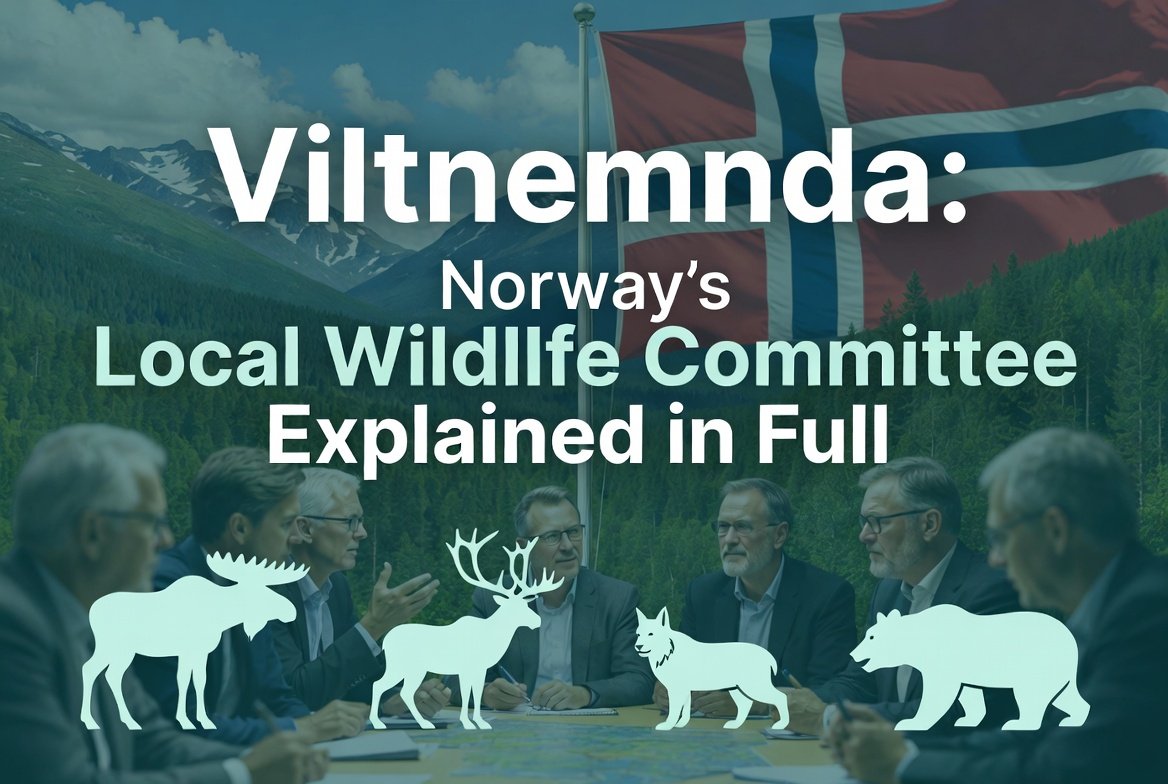
Norway is internationally recognised as one of the most effective countries in the world when it comes to environmental management and wildlife conservation. A significant part of that reputation rests not on centralised bureaucracy but on a decentralised governance structure that gives local communities real authority over the wildlife in their immediate environment. At the heart of this structure is the viltnemnda, the municipal wildlife committee that operates in every Norwegian municipality and serves as the practical interface between national wildlife policy and local ecological reality.
What Is Viltnemnda?
The word viltnemnda is Norwegian and translates directly as wildlife committee or game committee. It is composed of two parts: vilt, meaning wildlife or game, and nemnda, meaning committee or board. Together, the term describes a locally appointed governing body responsible for managing wild animal populations and wildlife-related issues within a specific Norwegian municipality.



Every Norwegian municipality, of which there are several hundred, is required to establish a viltnemnda or equivalent body under Norwegian wildlife legislation. Each committee is composed of locally appointed members who bring relevant knowledge and experience to their roles, including backgrounds in hunting, farming, forestry, environmental science, and local governance.
The viltnemnda does not create laws. Its authority is derived from and bounded by national legislation, particularly the Wildlife Act and the Nature Diversity Act, which define both what the committee must do and what it is empowered to decide at the local level. Within those boundaries, however, the committee has genuine decision-making authority, allowing it to adapt national policy to local conditions in ways that a purely centralised system could not achieve.
Legal Framework
The viltnemnda system rests on a solid and carefully developed legal foundation. Two pieces of national legislation are particularly important.
The Wildlife Act (Viltloven)
Norway’s Wildlife Act, first enacted in 1981 and subsequently amended multiple times, is the primary legal instrument governing wildlife management in Norway. It establishes that wildlife is a national resource, defines species that may be hunted and under what conditions, sets standards for sustainable harvesting, and explicitly creates the framework within which municipal wildlife committees operate. The Act grants municipalities authority to manage specific aspects of wildlife within their territories and positions the viltnemnda as the instrument through which that authority is exercised.
The Nature Diversity Act (Naturmangfoldloven)
Enacted in 2009, the Nature Diversity Act expanded the ecological obligations of all public bodies, including viltnemndas, to consider biodiversity conservation principles in their decision-making. Under this Act, the viltnemnda must consider not only the population levels of the species it manages but also the broader ecological functions those populations serve, including their roles in predator-prey dynamics, vegetation management, and habitat connectivity. This dual mandate, as both a game management authority and a biodiversity governance body, reflects the integrated approach that characterises Norwegian environmental policy.
Structure and Membership
A viltnemnda is typically established by the municipal council and composed of locally elected or appointed representatives. The membership is deliberately designed to be cross-sectoral, bringing together people who represent the different interests and knowledge bases relevant to wildlife management in that particular area.
Common backgrounds among viltnemnda members include hunters and hunting organisations, farmers and landowners, forestry workers, environmental professionals and local conservationists, and elected municipal councillors. This diversity ensures that decisions are informed by both scientific data and practical, on-the-ground experience, and that the range of stakeholder perspectives that wildlife management affects are represented in the deliberative process.
Members serve for defined terms, typically aligned with the municipal electoral cycle, and decisions are generally made by consensus or majority vote within the committee. The committee meets regularly throughout the year, with additional meetings called when urgent issues arise such as unusual wildlife incidents or public safety concerns.
Supervision and Oversight
Although the viltnemnda has meaningful local authority, it does not operate without oversight. The Norwegian system has a layered governance structure that maintains national standards while enabling local adaptation.
The Norwegian Environment Agency (Miljødirektoratet) provides national guidance, scientific research, and policy direction that viltnemndas must follow. The County Governor (Statsforvalteren) provides regional supervision, ensuring that municipal decisions conform to national legal standards and offering a channel for appeal and review of committee decisions. Decisions that exceed the committee’s authority or conflict with national standards can be challenged and overturned through these administrative channels.
This layered system creates a resilient governance structure in which local knowledge and community involvement are valued and empowered, but not at the cost of national conservation standards or legal consistency.
Key Responsibilities of the Viltnemnda
Setting Hunting Quotas
One of the viltnemnda’s most important and most visible responsibilities is the setting of local hunting quotas for game species within the municipality. This is particularly significant for moose, red deer, and reindeer, which are central to Norwegian hunting culture and whose populations must be carefully managed to prevent ecological damage and human-wildlife conflict.
Quota decisions are based on population surveys, scientific data on reproductive rates and habitat capacity, historical hunting records, and observations from hunters and landowners in the field. The committee must balance the desire to maintain robust hunting opportunities with the need to ensure that populations remain at sustainable levels and that the broader ecological roles those populations serve are preserved.
Managing Human-Wildlife Conflict
Wildlife does not respect administrative boundaries, and in many Norwegian municipalities there are ongoing tensions between wildlife populations and human land use. Moose collide with vehicles on roads and railways. Deer consume crops and damage fences. Bears and wolves threaten livestock in agricultural areas. The viltnemnda serves as the primary local authority for addressing these conflicts.
The committee’s tools for managing conflict include authorising compensation for landowners who suffer crop or property damage from wildlife, coordinating controlled culling operations when necessary, supporting the implementation of preventive measures such as fencing and deterrents, and providing advice and guidance to affected parties.
Roadkill and Injured Wildlife
Vehicle collisions with large animals are a significant public safety and animal welfare issue in many parts of Norway. The viltnemnda coordinates the local response to these incidents, ensuring that injured animals are humanely dealt with and that carcasses are handled appropriately. The committee works with local authorities and emergency services to develop protocols for managing these situations quickly and safely.
Habitat Protection and Land Use Coordination
Wildlife management is inseparable from habitat management. The viltnemnda participates in local planning processes to ensure that development decisions consider their ecological implications. Road construction, forestry operations, tourism infrastructure, and residential development can all fragment or degrade wildlife habitat. By engaging with municipal planning departments, the viltnemnda helps ensure that critical breeding areas, migration corridors, and feeding grounds are identified and protected before development proceeds.
Data Collection and Population Monitoring
Effective wildlife management depends on accurate data about animal populations. The viltnemnda coordinates local efforts to gather this data, organising population counts, collecting hunting statistics, logging wildlife observations, and reporting ecological trends to regional and national authorities. Hunters play an important role in this data collection, providing observations and harvest records that significantly extend the committee’s ability to monitor what is happening across large and often remote areas of the municipality.
Public Education and Stakeholder Engagement
The viltnemnda has an important communicative function beyond its administrative and regulatory roles. It informs local hunters about changes in legislation and hunting conditions, facilitates dialogue between farmers, hunters, conservationists, and other stakeholders with different interests in wildlife, and provides information to the general public about wildlife management decisions and their rationale.
This engagement function is essential to the legitimacy and effectiveness of local wildlife governance. When communities understand why decisions are made and have had a genuine opportunity to contribute to the deliberative process, compliance is higher and conflicts are reduced.
Moose Management: A Case Study in Viltnemnda Effectiveness
Norway has one of the highest moose densities in Europe, and managing moose populations is among the most important and complex responsibilities of many viltnemndas. Moose cause significant vehicle collisions, particularly on roads and railways in forested areas. They also graze heavily on young trees, affecting forestry productivity. At the same time, moose are central to Norwegian hunting culture and the meat they provide is a significant source of food and income for local communities.
Through careful quota management, regular population monitoring, and adaptive adjustment of harvest levels based on observed data, many Norwegian municipalities have successfully maintained moose populations at levels that balance these competing interests. Human-wildlife collision rates have been reduced in areas where quota management has been effective, and moose hunting continues to generate substantial economic and cultural value for rural communities.
This outcome has not been achieved through centralised top-down management. It has been achieved through the viltnemnda system, where local knowledge, community involvement, and evidence-based decision-making combine to produce governance that is responsive to both ecological and human needs.
The Predator Management Challenge
Few issues in Norwegian wildlife management generate as much public controversy as the management of large predators. Wolves, bears, lynx, and wolverines are all legally protected species in Norway, yet they also pose genuine challenges for livestock farming in rural areas. The tension between conservation obligations and the practical concerns of farmers who lose sheep and cattle to predation is intense and politically sensitive.
The viltnemnda plays a role in implementing national predator policy at the local level, which means navigating these tensions within communities where opinions are deeply divided. The committee must apply national legal protections for predators while also taking seriously the economic impacts on farmers and the cultural significance of traditional livestock practices. This balancing act requires careful deliberation and strong communication skills alongside ecological knowledge.
The Viltnemnda Model as an International Example
Norway’s approach to local wildlife governance through viltnemndas has attracted interest from wildlife management practitioners in other countries who are looking for models that integrate local knowledge and community involvement into conservation governance without sacrificing scientific rigour or legal accountability.
The key features that make the model effective and potentially transferable include the genuine devolution of decision-making authority to a local level, the cross-sectoral composition of the committee that brings together different forms of expertise and stakeholder interest, the clear legal framework that defines both the committee’s authority and its obligations, and the layered oversight system that maintains national standards without undermining local autonomy.
Countries with similar ecological management challenges, particularly those managing deer, elk, or other ungulate populations in landscapes where agriculture and wildlife interact, have studied the Norwegian model as a reference point for their own governance reforms.
Challenges Facing Viltnemndas
Despite the effectiveness of the system, viltnemndas face real and growing challenges. Climate change is altering the behaviour and distribution of many species, shifting breeding seasons, disrupting migratory patterns, and changing the composition of vegetation that wildlife populations depend on. Committees must continuously update their management approaches in response to these changes, often without clear precedent to guide them.
Many municipalities, particularly smaller and more rural ones, operate with limited budgets and small staff. Conducting wildlife surveys, engaging stakeholders, and managing an increasing volume of human-wildlife conflict incidents requires time and resources that are not always available. As demands on the system grow, there is pressure to find more efficient approaches to data collection and community engagement.
The intensification of the predator debate, particularly around wolves, has also created political pressure on some viltnemndas that makes scientifically grounded decision-making more difficult. When wildlife management becomes a proxy for broader political conflicts about rural identity and the relationship between urban and rural values, the committee’s ability to function as a neutral technical body is challenged.
Frequently Asked Questions About Viltnemnda
What does viltnemnda mean in English?
Viltnemnda translates from Norwegian as wildlife committee or game committee. It refers to the locally appointed body responsible for managing wildlife in a Norwegian municipality.
Who appoints the members of a viltnemnda?
Members are typically appointed by the municipal council, often for terms that align with the municipal electoral cycle. Members are selected to represent a range of relevant backgrounds including hunting, farming, environmental management, and local governance.
Does the viltnemnda have the power to make laws?
No. The viltnemnda operates within the framework of national legislation and does not create laws. It has decision-making authority in specific areas, such as setting local hunting quotas, within the boundaries established by the Wildlife Act and the Nature Diversity Act.
How does the viltnemnda relate to national wildlife authorities?
The viltnemnda works within a layered governance system. National policies and minimum standards are set by the Norwegian Environment Agency. Regional oversight is provided by the County Governor. The viltnemnda implements and adapts these policies at the municipal level, with its decisions subject to appeal and review through the administrative hierarchy.
Is the viltnemnda involved in managing large predators?
Yes, to a degree. The viltnemnda plays a role in implementing national predator management policy at the local level, including managing compensation for livestock losses and coordinating responses to specific incidents. However, decisions about the overall status of protected predator species are made at the national level.