

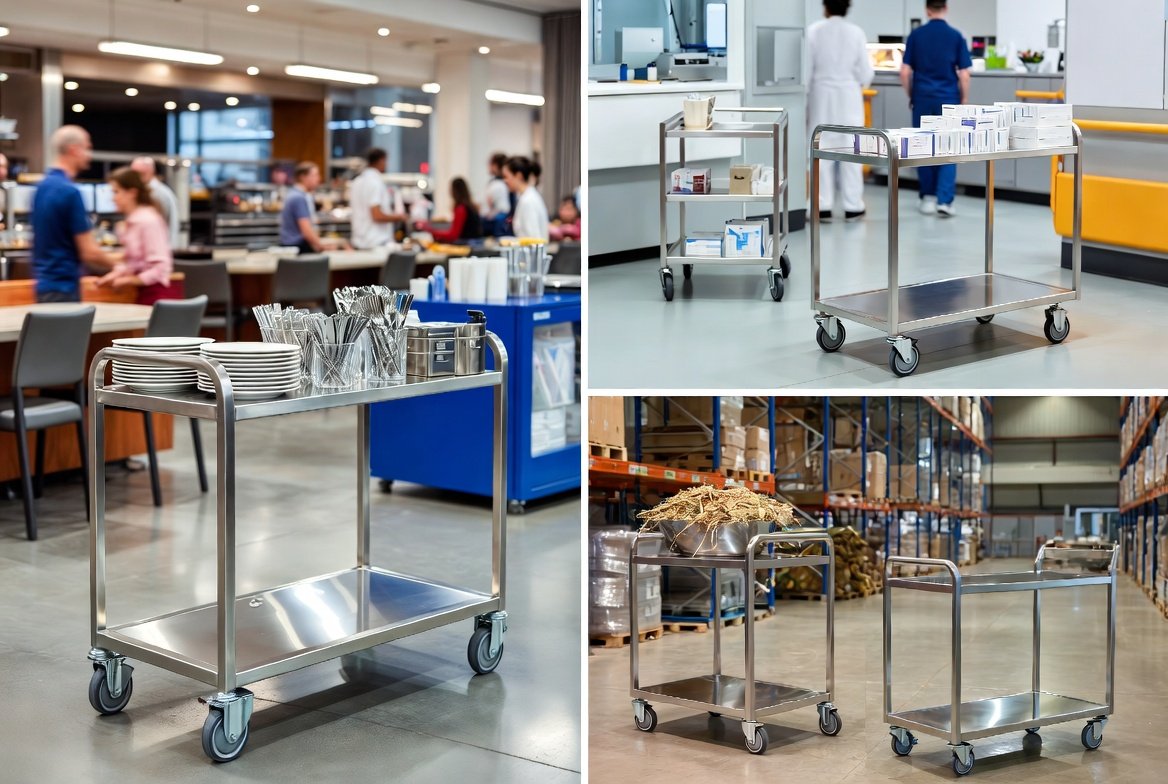
In a busy restaurant kitchen, a member of staff pushes a wheeled cart between tables, collecting stacked plates, glasses, and cutlery in a single efficient pass. In a Dutch agricultural field, a tractor pulls a purpose-built wagon that gathers harvested root vegetables from the ground as it moves. In a hospital corridor, a utility cart transports soiled linen from ward rooms to a collection point. In a construction site, a wheeled platform moves debris from the work area to a skip.
What Does Afruimwagens Mean?
The word afruimwagens comes from Dutch. It combines two components: afruimen, which means to clear away, to tidy up, or to remove, and wagens, which is the plural of wagen, meaning cart, wagon, or vehicle. Together, afruimwagens translates literally as clearing carts or removal wagons, which is a precise description of their core function.


The term is used broadly in Dutch-speaking contexts to describe any wheeled transport unit whose primary purpose is to collect, move, and clear materials from one location to another. The materials in question vary enormously depending on the industry and the specific design of the equipment, but the underlying concept of organised, efficient material movement remains constant.
The Core Purpose of Afruimwagens
The reason afruimwagens exist is straightforward: moving materials manually is inefficient, physically demanding, and in many operational contexts, unsafe. Without purpose-built carts designed for the task, workers must make repeated individual trips, carry unstable loads, risk spills and injuries, and spend time that could be devoted to more skilled tasks on basic material transport.
An afruimwagen solves this by consolidating multiple items into a single, stable, easily manoeuvred load that can be moved in one pass rather than many. The time saved across a busy working day is significant. The physical strain on workers is reduced. The risk of breakage, contamination, or injury associated with manual carrying is lowered. And the overall workflow of the operation becomes more organised and predictable.
These benefits apply whether the afruimwagen in question is a simple two-shelf stainless steel trolley in a restaurant or a large hydraulic agricultural wagon attached to a tractor. The scale and complexity differ enormously, but the principle is identical.
Types of Afruimwagens by Industry
Hospitality and Food Service Afruimwagens
In restaurants, hotels, cafeterias, and catering environments, afruimwagens are indispensable operational tools. The typical hospitality afruimwagen is a multi-shelf trolley built from stainless steel or food-grade plastic, designed to stack plates, trays, and cutlery securely during collection. The shelves are sized to accommodate standard plate dimensions, and some models include dedicated racks for glasses or cutlery sorting sections that separate items during collection.
During a busy service period, a well-designed afruimwagen allows a single staff member to clear multiple tables in a single circuit of the dining room, dramatically reducing the number of trips between the floor and the kitchen. In upscale dining environments, enclosed cart designs prevent guests from seeing accumulated dirty dishes, maintaining the aesthetic standards of the service environment.
In institutional catering settings such as hospital food service departments, university dining halls, and large event venues, tray return afruimwagens are standard equipment, with features including tray-stacking platforms, waste separation bins, and sturdy wheels designed for high-volume daily use.
Agricultural Afruimwagens
In Dutch and broader European agriculture, the term afruimwagen refers to a substantially different category of equipment. Agricultural afruimwagens are heavy-duty wagons built to handle the demands of field-based operations, including the transport of harvested crops, distribution of animal feed, movement of manure and compost, and general farm material handling.
These are not hand-pushed trolleys but substantial mechanised vehicles. Many are designed to be towed by tractors, and more advanced models include hydraulic tipping mechanisms for unloading, onboard conveyors for distributing material, and GPS guidance systems that allow precise application of materials across field surfaces.
In the context of precision agriculture, where the goal is to apply nutrients, compost, or manure at exactly the right rate in exactly the right locations across a field, modern agricultural afruimwagens have become sophisticated tools equipped with sensors, automated controls, and data recording capabilities that connect to farm management software.
The environmental dimension of agricultural afruimwagens has become increasingly important. Uniform and controlled distribution of organic materials reduces nutrient runoff, improves soil health, and supports compliance with regulations governing agricultural emissions and water quality.
Healthcare Afruimwagens
In hospitals, clinics, and care homes, purpose-designed afruimwagens are essential for maintaining hygiene standards and operational efficiency. Different types are deployed for different tasks: soiled linen transport carts, waste removal wagons, medication trolleys, and equipment transport carts are all variants on the afruimwagen concept adapted for clinical environments.
Healthcare afruimwagens are typically built from smooth, easily sanitised materials with minimal joints or crevices where contaminants could accumulate. They often include lockable compartments to control access to medications or clean supplies, and the wheels are designed to roll quietly on hard hospital floors without creating the noise that would disturb patients.
Industrial and Warehouse Afruimwagens
In manufacturing facilities, warehouses, and logistics centres, afruimwagens serve as the connective tissue of internal material flow. They carry components from storage to assembly lines, remove finished products and waste from production areas, and move goods between different zones of a facility.
Industrial afruimwagens are built for durability and load capacity rather than aesthetic considerations. Heavy gauge steel, reinforced wheels, and braking systems are standard features. Some industrial carts are designed for specific materials, with features such as tilting platforms for ergonomic loading, side rails for containing irregular loads, and specialised bins for sorting recyclable or hazardous materials.
Construction Afruimwagens
Construction sites generate continuous streams of waste material including rubble, timber offcuts, packaging, and mixed debris that must be cleared efficiently to maintain a safe and organised workspace. Construction afruimwagens are typically large, robust wheeled platforms or skip-on-wheels systems designed to carry heavy and irregular loads from the work face to designated disposal points.
Keeping construction sites clear of accumulated waste is not just an efficiency issue but a safety one. Cluttered work areas increase the risk of trips and falls, obstruct emergency access routes, and create fire hazards. Afruimwagens make systematic waste removal more practical and encourage regular clearing behaviour among site workers.
Key Design Features of Effective Afruimwagens
| Feature | Why It Matters |
|---|---|
| Load capacity | Determines how much can be moved in a single trip, directly affecting efficiency |
| Material construction | Stainless steel for food/medical environments, heavy steel for industrial, plastic for lighter indoor use |
| Wheel type and size | Determines suitability for different surfaces from restaurant tiles to field terrain |
| Shelf or platform layout | Should match the items being transported for stable, efficient loading |
| Hygiene design | Smooth surfaces with minimal joints for food and healthcare applications |
| Ergonomic handles | Reduces physical strain on operators over long working days |
| Braking system | Essential for loaded carts on sloped surfaces or in busy environments |
| Noise level | Critical in hospital and hotel environments where quiet operation is required |
The Business Case for Investing in Quality Afruimwagens
For businesses that rely on regular material movement, the return on investment from well-designed afruimwagens is typically strong and achieved relatively quickly. The calculation involves comparing the cost of the equipment against the operational benefits it generates.
In a restaurant context, the relevant benefits include faster table turnover, reduced staffing requirements for clearing and resetting, lower breakage rates from carrying individual items, and improved staff welfare through reduced physical demands. A table that turns 15 minutes faster during a busy service period represents meaningful additional revenue over the course of a week.
In agricultural applications, the relevant benefits include reduced fuel consumption from fewer field passes, lower labour costs, improved distribution accuracy that reduces input waste, and potentially improved crop yields from better soil management. Modern precision agricultural afruimwagens can demonstrate their ROI through the data they collect, showing measurable improvements in application uniformity and field productivity.
In healthcare settings, the relevant benefits include improved infection control through proper waste segregation, reduced manual handling injuries among staff, and more efficient ward operations that contribute to patient care quality.
Choosing the Right Afruimwagen for Your Needs
The key to selecting an appropriate afruimwagen lies in clearly defining the task it needs to perform before evaluating specific models. Questions worth addressing include the weight and volume of material to be moved in a typical session, the surface type the cart will operate on, the hygiene standards required by the environment, the available space for storage and manoeuvring, the frequency of use and expected operational lifespan, and the maintenance capabilities of the team that will use and care for the equipment.
Entry-level hospitality afruimwagens are available for a few hundred pounds or euros and are appropriate for smaller operations with moderate use. High-volume catering operations will benefit from more robust models in the higher price range. Agricultural afruimwagens range from modest tractor-towed models to sophisticated precision application systems costing tens of thousands of euros depending on their capabilities.
Maintenance requirements should be factored into the total cost of ownership. Regular cleaning, wheel and joint inspection, and prompt replacement of worn components extend the operational life of afruimwagens significantly and prevent the kind of gradual performance degradation that reduces their effectiveness and increases the risk of failure at critical moments.
Frequently Asked Questions About Afruimwagens
What does afruimwagen mean in English?
Afruimwagen is Dutch for clearing cart or removal wagon. It refers to purpose-built wheeled carts and vehicles designed to collect and transport materials efficiently in operational environments ranging from restaurants to farms.
Are afruimwagens only used in the Netherlands?
No. While the term originates in Dutch, the equipment it describes is used across Europe and internationally. In English-speaking contexts the equivalent items are typically called bussing carts, service trolleys, utility wagons, or harvest wagons depending on the specific application.
What is the difference between an afruimwagen and a regular trolley?
Afruimwagens are purpose-designed for specific operational tasks, with features including shelf layouts, materials, load capacities, and hygiene specifications matched to their intended use. A generic trolley is a more basic piece of equipment without these task-specific design considerations.
How often should an afruimwagen be maintained?
In food and healthcare environments, cleaning should occur after every use or at minimum at the end of each working day. Mechanical inspection of wheels, joints, and structural components should happen regularly, typically weekly for high-use equipment and monthly for lower-use items.
Are electric afruimwagens available?
Yes. Battery-powered electric afruimwagens are increasingly available for both hospitality and industrial applications, reducing the physical effort required to move loaded carts across larger distances. Some agricultural models are available with hybrid or electric drive systems as part of sustainability-focused equipment lines.