

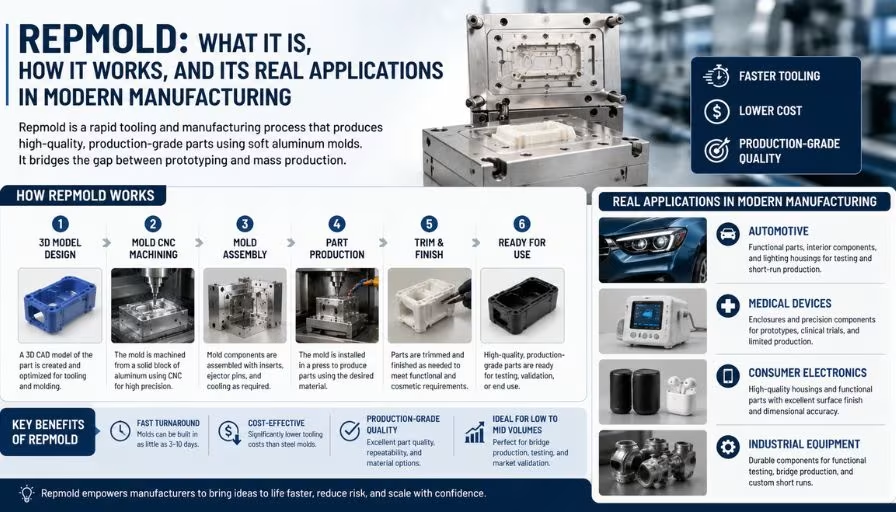
Manufacturing is fundamentally about achieving consistency. When a company produces a product, whether it is an automotive component, a medical device casing, a consumer electronics enclosure, or an industrial fitting, the requirement is always the same: every unit must meet specifications, every time, across thousands or millions of production cycles. This is the problem that mold-based manufacturing exists to solve, and repmold represents both a traditional methodology and an evolving approach to making that solution faster, more flexible, and more cost-effective.
What Is Repmold?
At its most fundamental level, repmold refers to manufacturing processes built around the replication of a defined form through the use of a mold. The mold acts as a master template: material is introduced in a flowable state, the mold shapes it, the material hardens or cures, and the result is a component that faithfully reproduces the geometry and surface characteristics of the mold interior.



This process is repeated as many times as required, with each cycle producing a component that matches the previous one to within the dimensional tolerances of the mold and the process. The reliability of this replication is what makes mold-based manufacturing the production method of choice for components that require consistency at scale.
In a more specific technical sense, repmold also refers to the process of making a highly accurate replica of an existing surface using specialist materials such as polyvinyl siloxane or other addition-curing silicone compounds. This application is used in quality control, forensic investigation, archaeological documentation, and surface analysis, where the goal is to capture the precise topography of a surface in a form that can be analysed, measured, or compared without requiring ongoing access to the original.
The Two Primary Contexts of Repmold
Repmold in Mass Manufacturing
In industrial manufacturing, repmold processes are central to producing consistent parts at volume. Injection molding, die casting, blow molding, compression molding, and transfer molding are all examples of processes that operate on repmold principles: a carefully engineered mold captures a defined geometry and allows it to be reproduced with high fidelity across large production runs.
The investment required to design and fabricate a high-quality manufacturing mold is substantial. Tool steel molds for injection molding processes can cost tens of thousands to hundreds of thousands of dollars, depending on the complexity of the part geometry, the number of cavities, the material being processed, and the production volumes expected. However, once made, a well-maintained mold can produce millions of parts before requiring replacement, spreading the fixed cost over an enormous number of units and driving the per-part cost down to levels that manual production could never approach.
Repmold in Surface Replication and Quality Analysis
In its more specialised sense, repmold refers to the technique of capturing a surface in three dimensions using cold-curing polymer systems. The process involves applying a low-viscosity, addition-curing silicone or resin to a prepared surface, allowing it to polymerise and cure while capturing the surface’s micro-topography with very high fidelity, and then removing the resulting replica for analysis or documentation.
The dimensional accuracy of high-quality repmold systems is exceptional. Addition-curing silicones used in professional repmold applications exhibit shrinkage of less than 0.1 percent, meaning the replica captures the original surface geometry to a degree of accuracy that allows measurement of features at the micron scale. This precision is what makes repmold surface replication valuable in applications where exact dimensional data is required.
Key Materials in Repmold Processes
The materials used in repmold processes vary significantly depending on the application, but several categories are particularly important.
Tool Steels for Manufacturing Molds
High-performance tool steels including P20, H13, and S7 grades are the standard materials for injection molding tools intended for extended production runs. These steels combine hardness, toughness, and wear resistance in proportions suited to the demands of repeated high-pressure, high-temperature molding cycles. Stainless steel variants are used where the molded material or the production environment creates corrosion risks. Aluminium alloys are used for lower-volume applications where the reduced tooling cost justifies acceptance of a shorter tool life.
Addition-Curing Silicones for Surface Replication
For surface replication applications, addition-curing polyvinyl siloxane systems are the material of choice in professional repmold work. These two-part systems combine a base silicone polymer with a platinum catalyst to initiate crosslinking, producing a flexible, dimensionally stable replica that captures surface detail at the micron level. The absence of any volatile by-products during curing, unlike condensation-curing systems that release water or alcohol, means there is minimal shrinkage and no risk of the curing process introducing artefacts into the surface replica.
Some professional repmold silicones are formulated to be thixotropic, meaning they flow readily under the pressure of application through a mixing nozzle but then resist further flow once applied to the surface. This allows repmold work to be carried out on vertical surfaces and in overhead positions without the material running off before it cures.
Industrial Applications of Repmold
Automotive Manufacturing
The automotive industry is one of the largest users of repmold technology. Interior components including dashboards, door panels, centre consoles, and trim pieces are produced through injection molding processes that require molds capable of producing millions of parts to identical specifications. Exterior components including bumpers, grilles, and body panels are produced through a combination of injection molding, blow molding, and compression molding depending on the geometry and material requirements.
Repmold surface replication is also used in automotive quality control, where dimensional verification of production parts is carried out by taking replicas of critical surfaces and measuring them against the original specification rather than requiring access to the original tool.
Aerospace Components
The aerospace industry applies repmold surface replication extensively in maintenance and inspection contexts. Turbine blades develop surface defects over service life including erosion, micro-cracking, and thermal fatigue damage. Repmold replicas allow maintenance engineers to document the rate and nature of surface degradation over successive inspection intervals without requiring removal of the component from the assembly. By comparing replicas taken at different service intervals, engineers can track damage progression and predict remaining service life.
Medical Devices
Medical device manufacturing relies heavily on repmold processes for producing components with the dimensional consistency and surface finish required for safe implantation or clinical use. Surgical instrument handles, diagnostic equipment housings, and implantable device components are all produced through mold-based processes that ensure every unit meets the same exacting specifications.
Forensic Science
One of the most compelling specialist applications of repmold technique is in forensic investigation. When a crime scene presents tool marks, shoe impressions, tyre tracks, bite marks, or other physical evidence that cannot be removed from the scene, repmold surface replication allows investigators to capture a permanent, highly accurate three-dimensional record of that evidence for laboratory analysis and eventual court presentation.
Forensic repmold materials are formulated specifically for the demands of crime scene work: they must cure quickly to minimise scene disturbance, must capture fine detail including the microscopic striations left by specific tool edges, and must produce replicas that remain dimensionally stable over the extended period between evidence collection and eventual court proceedings. When the tool or weapon suspected of producing a mark is recovered, forensic examiners can compare the mark replica against a test impression from the suspect item using microscopy to establish or exclude a match.
Cultural Heritage and Archaeology
Archaeologists and conservation professionals use repmold techniques to document artefacts, inscriptions, and architectural details without any risk of damage to the original. Stone inscriptions that would be too fragile or too large to transport to a laboratory can be captured in a repmold replica that allows all subsequent analysis to be carried out on the copy. Collections that are too sensitive to handle repeatedly can be documented through a single repmold session that produces study replicas usable by researchers indefinitely.
The Repair and Restoration Application of Repmold
In manufacturing and tooling contexts, repmold also refers specifically to the process of recreating a damaged, worn, or lost mold by using the original part or surface as a reference to produce a new or repaired tool. This application is particularly valuable when original mold drawings or CAD data are no longer available, when a mold has been damaged and replacement would require starting the design process from scratch, or when a component needs to be reproduced and the only reference available is an existing physical part.
The repmold repair process typically involves high-accuracy scanning of the original part using coordinate measuring equipment or 3D scanning technology, generation of a new tool design from the scan data, fabrication of the new or repaired mold component, and verification against the original part. This approach can recover production capability for legacy components without the full lead time and cost of a complete new tool design.
Modern Developments in Repmold Technology
The integration of digital technologies into traditional molding processes has significantly expanded what repmold approaches can achieve. Computer-aided design software allows mold geometries to be specified and simulated with a precision that was not previously achievable, reducing the trial-and-error iterations that historically added time and cost to tool development. Finite element analysis allows the thermal and mechanical behaviour of a mold in operation to be predicted, identifying potential failure points before the tool is fabricated.
Three-dimensional printing has introduced new possibilities for rapid prototyping of mold inserts and for the direct production of short-run tooling, allowing functional repmold-style production at quantities that would not previously have justified the investment in traditional steel tooling. Additive manufacturing is not a replacement for high-volume precision steel tooling, but it has created a useful intermediate category for bridge tooling and pilot production runs.
In surface replication, advances in material science continue to improve the performance of repmold compounds, pushing dimensional accuracy and curing speed further in the direction that demanding applications require.
Advantages and Limitations of Repmold
The advantages of repmold manufacturing are well-established and directly tied to the core requirements of industrial production. Consistency, scalability, and cost efficiency at volume are the primary drivers. A properly engineered mold produces identical parts with no variation that would arise from operator skill differences or fatigue. Cycle times are controlled and predictable. Material usage is optimised.
The limitations are equally real. Initial tooling investment is high, which creates barriers for very low volume production. Mold design and fabrication lead times can be significant, delaying time to market for new products. Once a mold is fabricated, making design changes requires either mold modification, which is sometimes possible but always adds cost, or fabrication of a new tool.
Repmold is not the optimal approach for every manufacturing scenario. For highly customised, one-off, or very low volume production, the mold investment is difficult to justify. For components with complex internal geometries that cannot be demoulded from a conventional tool, alternative processes may be required.
Frequently Asked Questions About Repmold
What does repmold mean?
Repmold derives from replication and molding. It refers to manufacturing processes based on the repeated use of a mold to produce consistent parts, and specifically to the technique of recreating an existing surface or mold with high dimensional accuracy using specialist polymer materials.
How accurate is repmold surface replication?
Professional addition-curing silicone repmold systems can achieve shrinkage of less than 0.1 percent, allowing surface features at the micron scale to be captured accurately enough for measurement, comparison, and forensic analysis.
What industries use repmold most extensively?
Automotive, aerospace, medical devices, consumer electronics, forensic science, and cultural heritage conservation are among the most significant users of repmold processes, though the technique appears across virtually any industry that requires dimensional consistency or accurate surface documentation.
Is repmold the same as 3D printing?
No. Three-dimensional printing builds objects additively, layer by layer, from a digital model. Repmold uses a physical mold to shape material into a defined form. The two approaches have complementary applications, and 3D printing is increasingly used to produce prototype or short-run repmold tooling, but they are distinct processes.
What materials are used in repmold surface replication?
Addition-curing polyvinyl siloxane silicones are the standard material for professional repmold surface replication. They combine dimensional stability, flexibility, and the ability to capture fine surface detail with the rapid curing and ease of application required for field use.