

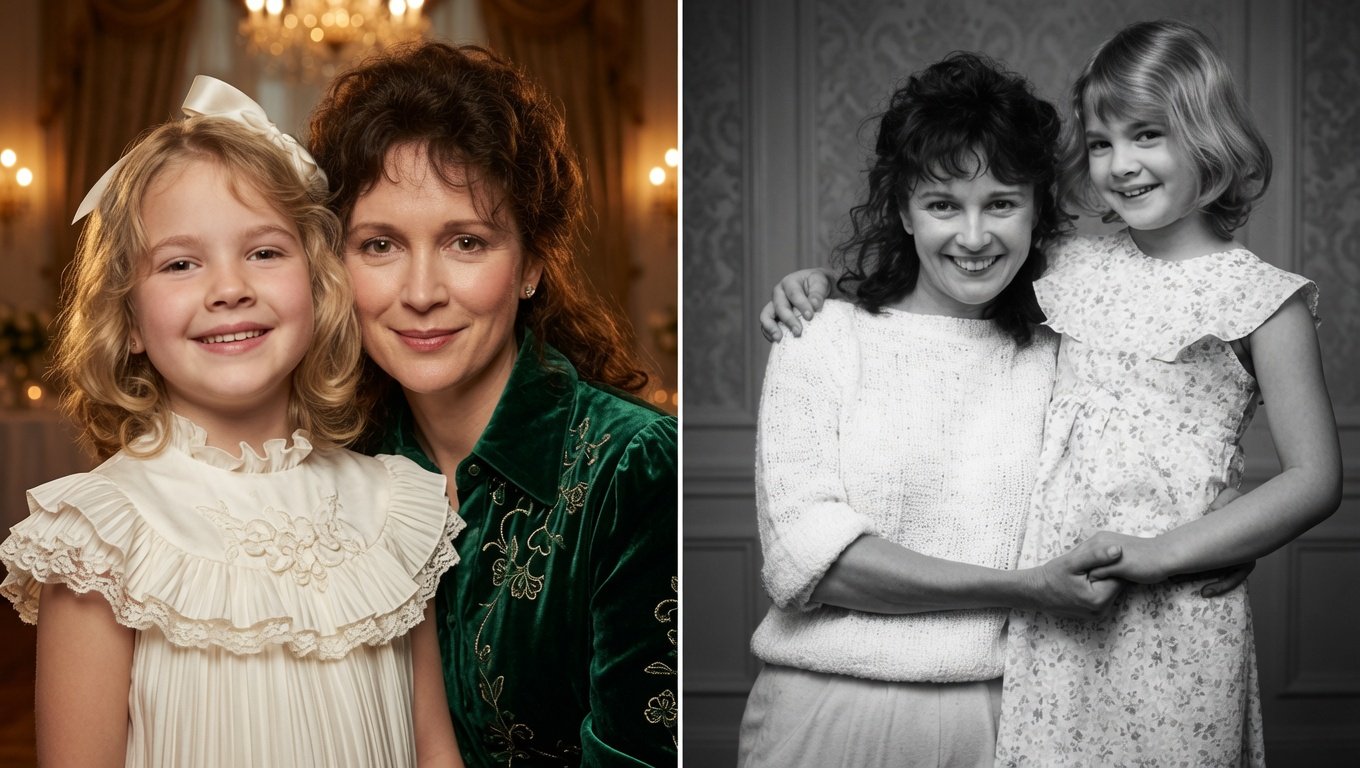
Few parent-child relationships in Hollywood history have generated as much public discussion as the one between Drew Barrymore and her mother, Jaid Barrymore. The story is well-known in outline: a child thrust into fame at seven, nightclub visits with her mother at twelve, drug rehabilitation at thirteen, emancipation from her parents at fourteen. These facts have been repeated so many times that they have calcified into a simple narrative in which Jaid is the villain and Drew is the survivor.
Jaid Barrymore Quick Biography
| Detail | Information |
|---|---|
| Full Name | Ildikó Jaid Makó (later Jaid Barrymore) |
| Date of Birth | November 28, 1946 |
| Age (2026) | 79 years old |
| Birthplace | Displaced persons camp, Germany (post-WWII) |
| Heritage | Hungarian |
| Immigration | United States, age approximately 17, speaking no English |
| Marriage | John Drew Barrymore (married 1974, divorced 1984) |
| Daughter | Drew Barrymore (born February 22, 1975) |
| Acting credits | Several minor film and television appearances in the 1970s–1990s |
| Playboy appearance | 1995, marketed as “Drew’s Sexy Mom” |
| Current status | Alive, location private, financially supported by Drew |
Who Is Jaid Barrymore?
Jaid Barrymore, born Ildikó Jaid Makó on November 28, 1946, is a Hungarian-born American actress and the mother of Drew Barrymore. She was born in a displaced persons camp in Germany in the immediate aftermath of World War II, into a world of physical and psychological disruption that most people in comfortable Western lives cannot begin to imagine.



She is not simply a footnote in her daughter’s story, though that is how she is most commonly presented. She is a woman whose own life contained genuine ambition, genuine hardship, genuine love, and genuine failure, often in the same moment and in ways that are inseparable from each other. Jaid began taking a young Drew to auditions when she was just an infant, and at the age of seven Drew landed one of her most famous roles as Gertie in E.T.: The Extraterrestrial. What followed that success was not malice but inadequacy: a mother who did not know how to say no to a world that wanted everything from her daughter and increasingly from her too.
Born in the Ruins of Postwar Europe
Jaid Barrymore’s origin story begins in one of the most difficult possible circumstances. She was born in a displaced persons camp in Germany following World War II, to Hungarian parents whose lives had been shattered by the conflict. Displaced persons camps in the late 1940s were not temporary inconveniences. They were places of genuine deprivation, psychological trauma, and profound uncertainty about the future.
Her family had Hungarian roots, and life was filled with fear, loss, and survival. It was not a soft or easy start. Growing up with no true home, no national identity, and the specific trauma of camp life left marks that do not simply disappear when circumstances improve. The woman who would later be criticised for her parenting decisions was shaped fundamentally by an early life that gave her very few tools for stability.
At approximately seventeen years old, Jaid immigrated to the United States, arriving with no English and with the particular combination of vulnerability and determination that characterises people who have survived genuine adversity and emerged still wanting something better. New York was her first destination, and the city’s energy and competitiveness both attracted and tested her.
Acting Dreams and the Hollywood Journey
Jaid was drawn to acting and performance from her early years in America. She pursued opportunities in New York and eventually in Los Angeles, navigating the entertainment industry as a young immigrant woman with an accent, no connections, and no family support network in the country she had chosen.
Her acting career produced a modest body of work. She appeared in several minor film and television productions during the 1970s and 1980s, never achieving the kind of breakthrough that transforms an aspiring actress into a working professional with financial security. The industry, then as now, was extraordinarily difficult to sustain a career in, and Jaid was working without the advantages that make success more likely.
What she had was drive, physical presence, and the social confidence that surviving a difficult early life can produce. These qualities opened some doors and allowed her to move through the entertainment world’s social sphere even without the professional traction her ambitions required.
Marriage to John Drew Barrymore
Jaid married John Drew Barrymore in 1974. John Drew Barrymore was the son of the legendary John Barrymore, placing him within one of American theater and cinema’s most storied dynasties. His father’s brilliance had not translated smoothly into John Jr.’s life, however. He had struggled with addiction throughout his adult years, and his acting career, while containing some genuine work, never approached the heights of his father’s legacy.
The marriage was turbulent from an early stage. Estranged from her husband and Drew’s father, John Drew Barrymore, Jaid was left to raise Drew essentially alone after the marriage broke down. Drew was born on February 22, 1975, and John Jr. was largely absent from her childhood, appearing sporadically and unpredictably rather than with any consistency.
Being a single mother in Hollywood in the late 1970s, without financial stability, without family support, and without the professional success that would have provided resources, placed Jaid in an extremely difficult position. She was alone with a child in one of the world’s most expensive and socially complex cities, trying to manage her own ambitions while providing for a daughter who was becoming, entirely without either of them planning it, extraordinarily famous.
Drew’s Rise to Fame and Jaid’s Choices
When Drew was cast in E.T. at age seven, the nature of the challenge Jaid faced changed dramatically. Drew became the most recognisable child actress in America almost overnight, and the machinery of Hollywood stardom made demands on both of them that neither was prepared for.
Jaid treated Barrymore like a friend and client more than a daughter. They would go to industry parties, nightclubs, Studio 54, Limelight. She dated Drew’s boyfriends; after Barrymore posed nude for Playboy in 1995, Jaid followed suit later that year as Drew’s Sexy Mom. With no one to say no, Drew was uninhibited. At age 13, Barrymore had developed a pre-teen fondness of drugs and alcohol.
The decisions Jaid made during this period, taking a child to nightclubs, treating her as a social companion rather than a minor requiring protection, failing to establish boundaries against an industry that was more than happy to exploit a precocious child for commercial gain, were genuinely harmful. Drew’s subsequent struggles with substance use and mental health had their roots in this period, and the connection between Jaid’s choices and those struggles is not deniable.
Understanding why those choices were made does not excuse them but it does contextualise them. Jaid was a woman with no model for healthy parenting in her own background, no financial cushion that would have allowed her to step back from the opportunities Drew’s fame produced, and no external support system pointing her toward better decisions. She was overwhelmed by circumstances she had not chosen and made choices that any reflective person would recognise as wrong, without necessarily having the tools in the moment to choose differently.
Drew’s Emancipation and the Years of Distance
Drew Barrymore was legally emancipated from her parents at fourteen. This meant she was recognised by a court as capable of managing her own affairs, effectively ending Jaid’s parental authority over her daughter’s life. The emancipation followed a period that included Drew’s time in psychiatric care and rehabilitation facilities and reflected a genuine determination on Drew’s part to take control of a situation that had been damaging her.
Drew and her mother have never fully reconciled since she left the house at 14, though Barrymore still supports her financially. This financial support, maintained across decades of complicated relationship, says something important about Drew’s character: whatever her feelings about her mother, she has not abandoned her to the material consequences of an old age without resources.
The years between the emancipation and any tentative reconciliation were marked by distance, occasional public references by Drew to the damage of her childhood, and Jaid’s continuing attempts to maintain some kind of presence in the entertainment world. The 1995 Playboy appearance, marketed specifically as an extension of Drew’s own earlier nude modelling, is perhaps the starkest example of Jaid’s difficulty in establishing a separate identity from her daughter’s story.
Reconciliation and the Complex Present
In 2021, Drew spoke about reaching a point of peace with her mother. She told Oliver Hudson during an episode of her show: My mom and I are good now. It’s like there’s just some peace and respect and maturity there that could not have taken place maybe before.
But the relationship remains genuinely complicated. In a 2023 interview that generated significant media coverage, Drew said: I cannot wait. I don’t want to live in a state where I wish someone to be gone sooner than they’re meant to be so I can grow. I actually want her to be happy and thrive and be healthy. But I have to grow in spite of her being on this planet. She subsequently clarified these words, describing them as honest grief rather than hostility, and noting the difficulty of growing around rather than simply away from someone who is still alive.
The complexity of what Drew expressed is not simply about Jaid. It reflects a universal truth about complicated parent-child relationships: that love and damage can coexist, that forgiveness does not require pretending harm was not real, and that healing is rarely a clean linear process. Jaid, now 79 years old, carries the weight of being publicly identified as the source of her daughter’s most painful early experiences. That is not a comfortable position, whatever role one’s own choices played in producing it.
What Jaid Barrymore’s Story Is Really About
The easy version of Jaid Barrymore’s story is a cautionary tale about bad parenting. The more honest version is a story about the way that unaddressed trauma, structural poverty, and the specific pathologies of the entertainment industry can combine to produce harm that passes through generations.
Jaid was not raised to be a good parent. She was raised in conditions that actively worked against the development of the emotional regulation, boundary-setting, and child-centred thinking that healthy parenting requires. She arrived in America with nothing and spent her adult life trying to build something, often making decisions that prioritised her own survival and ambitions in ways that damaged her daughter. Those decisions were wrong. They were also human.
The fact that Drew has built a successful adult life, including her talk show, her production company, her three marriages, and her two daughters, suggests a person who has done the difficult work of processing a difficult past without being defined by it. The relationship with Jaid, complicated and unresolved as it remains, is part of that processing rather than a footnote to it.
Frequently Asked Questions About Jaid Barrymore
Who is Jaid Barrymore?
Jaid Barrymore, born Ildikó Jaid Makó on November 28, 1946, is a Hungarian-born American actress and the mother of Drew Barrymore. She was born in a displaced persons camp in Germany after World War II and immigrated to the United States as a teenager.
What is Jaid Barrymore’s relationship with Drew like today?
Their relationship remains complicated but has reached a more peaceful state in recent years. Drew has spoken about finding peace and maturity in the relationship while also being honest about the ongoing difficulty of healing from a painful childhood. Drew continues to support her mother financially.
Why was Drew Barrymore emancipated from her parents?
Drew was legally emancipated at fourteen following a difficult period that included time in psychiatric care and rehabilitation. The emancipation gave her control over her own affairs and effectively ended Jaid’s parental authority over her life.
Did Jaid Barrymore have an acting career?
Yes. She pursued acting in New York and Los Angeles from the late 1960s onward, appearing in several minor film and television productions. Her career never achieved significant commercial success.
Is Jaid Barrymore still alive?
Yes. As of 2026, Jaid Barrymore is 79 years old. Her location is not publicly confirmed, but Drew has spoken about their ongoing relationship and continues to support her financially.
Where was Jaid Barrymore born?
She was born in a displaced persons camp in Germany in 1946, to Hungarian parents who had been displaced by World War II. She later immigrated to the United States as a teenager.